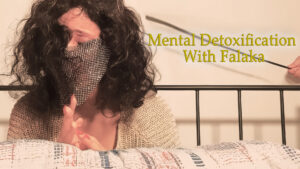
 This Blog Podcast is a translation of the Turkish blog post titled “Nasıl Dayanıyorsun” (How do you endure it) from the blog “slave Elif“. This post is inspired by Mental Detoxification With Falaka.
It doesn’t have much to do with the video’s content. Rather, it’s a description of an inner attitude and a social questioning of women’s rights, violence, and the disregard for human dignity, in contrast to the voluntary submission inherent in BDSM. BDSM, which values and respects human dignity, rules, boundaries, and the personality of each individual. Here, unlike in real life, no one is forced to submit or endure violence, where a “no” is respected without a word.
The author explores her deeply personal experiences and philosophy behind enduring physical pain within a BDSM (Bondage, Discipline, Sadism, Masochism) Master/slave relationship, specifically “falaka” (foot whipping). She contrasts this chosen suffering with the unappreciated and often destructive endurance of injustice in conventional society, particularly as it relates to women’s roles perpetuated by cultural narratives.
Here’s a breakdown of the key themes and arguments:
The Nature of Chosen Pain of Falaka
- The author is questioned about enduring pain, including candle burns and falaka, seen by others as cruel.
- She considers this pain her “greatest pleasure” and “reality” within her BDSM relationship.
- While the physical pain is real, she experiences happiness from the marks and wishes they would fade slower.
- She contrasts the pain of falaka, which she endures with pleasure, as far superior to the “far worse” pain she endured “selling herself” (implying past societal or personal compromises).
- For her, every pain has a reason, a price, and reveals beauty, with the ultimate reward being “beneath my Master’s feet.”
Adoration for Her Master
- She adores her Master’s heart and humanity, describing him as someone who profoundly impacts lives, changing perspectives and improving quality of life for others.
- He takes on difficult responsibilities and provides unwavering support, making his presence felt even from a distance.
- She believes he is an “exceptional human being,” a “perfect Master,” and would have been an angel in non-human form.
- Her journey with him is a conscious choice, and she expresses deep gratitude.
Contrast with Societal Endurance and Injustice
- The author feels uneasy about “life without BDSM” and critiques how people endure unchosen suffering in their social, family, and work lives.
- She questions what and whom people endure in conventional settings, noting a lack of empathy, common sense, and justice.
- She observes a “strange reality” where enduring injustice often leads to praise, as if endurance itself is a virtue. This leads people to “forget the truth and destroy themselves.”
- She differentiates her chosen and meaningful pain from those who are “knowingly allow themselves to be crushed” or who shame others for speaking up against injustice.
Influence of Fairy Tales and Gender Roles
- A book titled “Fairy Tales and Gender” deeply impacted her, revealing how childhood stories and cartoons manipulate perceptions.
- She argues that fairy tales propagate the image of an “acceptable woman” as obedient, non-rebellious, and suffering deeply to achieve her desires.
- She questions whether such self-sacrificing mothers truly brought happiness and suggests a preference for mothers who refuse to be crushed, savor life, and express themselves clearly, raising informed and strong children.
- Her BDSM pain is a conscious choice, whereas many women’s suffering is a “cruel fate” imposed upon them.
The Falaka Session and its Aftermath
- Before a specific falaka session, her Master acknowledged her agency by asking if she was ready, despite personal problems.
- She chose to proceed, believing her conscience would not be at ease if she fled.
- During the falaka, she endured the pain fully, describing it as “deserving” and aiming to be a “well-behaved girl.”
- Her answer to “How do you endure it?” is that she is happy no one could stop her falaka.
- The session concluded with her being “honored by being taken into my Master’s arms,” which she considers the ultimate desire for a slave.
- The post ends with the lingering physical sensation of terribly itching feet. In Turkish linguistic culture, “my soles are itchy” means that one wants the falaka.
How Do You Endure It?
This is a translation of a post from the Turkish blog “slave Elif“.
How Do You Endure It? – Mental Purification Through the Falaka
Someone I know once said to me, “How do you endure all this pain? Why do you put yourself through so much suffering? And on top of that, you let yourself be burned with candles. Isn’t that cruel to yourself?”
She was deeply upset by my situation. I am sure she wanted to rescue me from this life. The way she looked at me in disbelief and spoke, I listened to her with the same astonishment, watching her just as intently. I have never looked at things from where she stands. I have never thought or felt that way.
This is not merely my greatest pleasure. It is my reality. I want every moment and every feeling I experience with my Master to last forever. When it comes to my Master, I am shameless and insatiable.
The Moment I Enjoy Most While He Uses Me For His Own Pleasure
I feel pain physically, just like anyone else. It genuinely hurts. Redness and bruises appear. When I see them in the mirror, I feel happy. If there is one downside, it is that the marks fade too quickly. Sometimes the pain lasts briefly, sometimes longer.
My Master does not strike symbolically. On the contrary, the force of the blows often surprises even me. God forbid that I complain. I am not complaining.
Then my mind wandered to the pain I endured while selling myself. Compared to the falaka, the pain there was far, far worse. The moment I enjoy the most while he uses my body for his own pleasure is also the moment I am in the greatest pain. What I mean is this: I endure my pain with pleasure. Every one of them has a reason and a price. Each reveals a different kind of beauty. And above all, I would not trade the taste of being beneath my Master’s feet for any comfort in the world.
I Set Out on This Path With You
Not only because he is my Master. My Master is someone whose heart and humanity I adore. He touches people’s lives in such a way that their perspectives change and their quality of life improves. They continue their journeys with renewed hope and excitement. He takes on responsibilities that no one else would dare to shoulder, even when his heart is heavy for them.
The path my Master invites one onto is difficult and demands sacrifice. Yet throughout the process, he never leaves anyone alone.
Despite the distance, he makes his presence felt more closely and sincerely than those who are physically near. Those who listen to his advice, or those who have lost him, understand his value best. Had he not been created in human form, I believe he would have been an angel. I am grateful that you exist, my Master. I am grateful that I set out on this path with you.
When I Look at Life Without BDSM
Everything I live within BDSM is my choice. My insistence on remaining my Master’s slave despite all my mistakes and inadequacies is my own decision. It may sound strange, but what I truly feel is this: my Master and his other slaves are the ones who experience slavery at its most luxurious level. That is because my Master is an exceptional human being and a perfect Master.
At the end of the falaka, as I said to my Master, “There are some things you should not endure.” As I said this, I was thinking about our social lives outside BDSM. In family life, at work, in the street, what and whom do we endure? Is it appreciated? Even if it is appreciated, surely not everything deserves endurance. What we are left with are worn-out souls and bodies, exhausted by entitled people and ever-growing responsibilities.
When I look at life without BDSM, I feel uneasy. Trust, empathy, common sense, kindness, warmth, peace, justice… We are not able to live these values as we deserve to.
The Question: How Do You Endure It?
Against this backdrop, it naturally causes astonishment that someone can entrust themselves so completely to another and endure so much “pain”. That is where the question arises: how do you endure it? I am not encouraging impatience, intolerance or rebellion. Of course, we must show tolerance appropriate to people and circumstances. We cannot abandon the truths and values we believe in. But first and foremost, one must protect one’s own life.
There is also this strange reality: the more injustice you endure, the more praise you receive. As if endurance itself were a virtue. As if this is how it is supposed to be.
Fairy Tales and Gender Roles
If you ask them, they would never behave that way themselves. No one questions or prevents bad behaviour, yet the more burden you carry, the more you are praised. Look how beautifully they endured so much evil and “pain”.
As people submit to injustice, they forget the truth and destroy themselves, believing they must endure even more. Some do this by choice, others out of necessity. My words are for those who knowingly allow themselves to be crushed, who see this as an achievement, and who shame those who speak up for their lives and personal rights, whether the injustice is small or great. Those who say, “I stayed silent, you should too. Look at what I endured, you should endure it as well.”
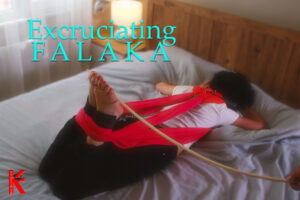
I once bought a book after being struck by the text on its back cover, “Fairy Tales and Gender”. Every subject it touches lands like a stick on the soles. Yes, do not forget the falaka, and do not let it be forgotten. After all, this is a falaka session text.
The truths I confronted saddened me deeply. I am an adult woman. Like everyone else, I have lived through, seen and heard countless forms of cruelty. I should have read this book much earlier. We have been deceived, manipulated. And it is still going on.
The Last Heavy Blows I Begged My Master For
On one hand, the book shows that the fairy tales, stories and cartoons we grew up with were not as innocent as we believed, shattering the child within us. On the other, it forces us to question our adult selves. I began this text with endurance, and here again the book shook me. No one asks, “How do you endure this?”
The lines I kept returning to and rereading were like the final heavy blows I begged my Master for at the end of the falaka.
Regardless of age or gender, everyone has been forced at some point in their lives to endure bullying inflicted by another. Some for a short time, others, sadly, for a lifetime. They were exploited, kept ignorant, misled. They were convinced that this cruelty was normal. They then dragged the next generations down the same path, believing it to be right.
How much our women, our mothers, endured. Some of them could not endure at all.
I Kiss The Soles Of All Women’s Feet
“… Fairy tales tell us that the acceptable woman is obedient, non-rebellious, unangry, and that only if she suffers deeply, becomes miserable, even ill from her sorrow, and displays her sacrifice, will she obtain what she wants. But are we sure that all men desire such a woman?
Or let us ask it this way: were we happy with mothers who swallowed everything until they became ill, whose suffering and sacrifices for those who oppressed them we witnessed, and with whom we grew up dreaming of compensating their losses, yet always feeling inadequate in doing so? Or would we have preferred a mother who refused to be crushed, who savoured life fully, who made travel plans for the future instead of clinging to unresolved accounts of the past, who neither sulked nor broke, but clearly expressed her stance and opinions, raising us to be informed and strong against life?”
My pain is a choice. Theirs, sadly, was a cruel fate.
I kiss the soles of all women’s feet.
The slave Was Honored
Before the falaka began, because of certain problems in my family and work life, I was not sure whether I could endure it. As my Master always does, he showed his difference by asking whether I was ready. I could have chosen the easy way and fled from pain. Would my conscience have been at ease? Never. I was ready for whatever my Master deemed appropriate.
During the falaka, I thought of no one and nothing. I felt the “pain” throughout my entire body, as I deserved to. I tried to endure, being a well-behaved girl. This is my answer to the question, how do you endure it. I am happy that no one could stop my falaka.
In the end, this slave was honored by being taken into my Master’s arms. What more could a slave want.
I lost count of how many blows I received.
The soles of my feet are still itching terribly.